Gnocco Fritto & Torta Fritta: The Fried Bread That Unites Emilia-Romagna
One of Italy's most ancient and beloved street foods
Paolo
3/15/20265 min leggere
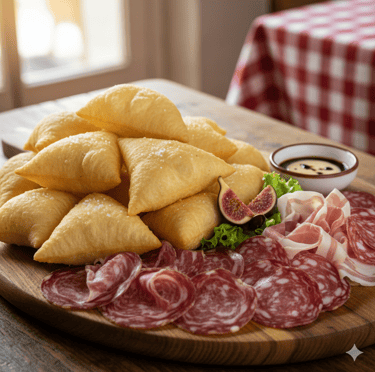
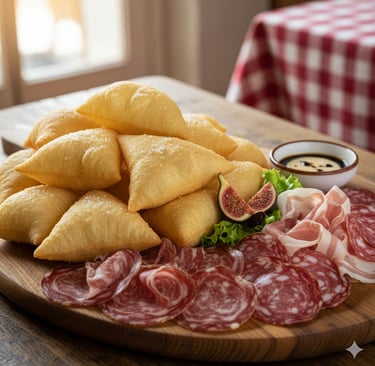
Walk into any bar, trattoria, or sagra across the Emilia-Romagna plain and you'll encounter it: a golden, puffed pillow of fried dough, served piping hot alongside a board of salumi. Depending on which province you're in, locals will call it something different — but they'll all insist their version is the original.
Welcome to the world of gnocco fritto — also known as torta fritta, crescentina, pinzino, or chisolino, depending on where you're standing. Few dishes capture the identity and history of Emilia-Romagna as completely as this humble, irresistible fried bread. In this guide, I'll take you through its origins, its regional variations and how it's made.
What Exactly Is Gnocco Fritto?
Gnocco fritto is a type of fried bread made from a simple dough of flour, water, salt, and lard (strutto). The dough is rolled thin, cut into diamond or rectangular shapes, and dropped into boiling lard or oil until it puffs up into light, hollow, crispy-golden pillows with a soft interior.
The name may confuse foreign visitors who associate "gnocco" with potato gnocchi found in other regions of Italy. In Emilia, it refers exclusively to this fried bread.
It is officially listed as a Prodotto Agroalimentare Tradizionale (PAT) — a Traditional Italian Agri-Food Product — by the Italian Ministry of Agriculture. In Modena, a dedicated Confraternita del Gnocco d'Oro (Brotherhood of the Golden Gnocco), founded in 2008, exists solely to protect and celebrate its culture.
Ancient Origins: A Lombard Legacy
The history of gnocco fritto stretches back more than 1,400 years. Its origins are linked to the Lombard (Longobard) invasion of the Italian peninsula in 568 AD. The Lombards settled across what is now Emilia-Romagna and brought with them a diet heavily centred on pork fat. Lard (strutto), extracted from pigs slaughtered in autumn, became both an ingredient in the dough and the cooking medium. Combined with flour, water, and salt, it produced a poor man's bread: simple, nourishing, calorie-dense, and fast to prepare.
Until well into the 1950s, gnocco fritto was the staple breakfast of rural communities across the region — eaten with whatever salumi and cheese were available, to fuel a full day of agricultural labour.
The Five Regional Names: One Dish, Many Identities
Travel the length of the Via Emilia — the ancient Roman road running from Piacenza to Rimini — and you'll encounter a different name for this dish in almost every province.
Gnocco Fritto — Modena & Reggio Emilia Considered by many the closest to the original. Made with flour, lard, sparkling mineral water, and salt — no yeast. The carbonation in the water makes the dough puff during frying.
Crescentina — Bologna The Bolognese version adds whole milk and a small amount of leavening, producing a slightly softer result. (Important note: in Modena, "crescentina" refers to the tigella — a completely different bread. Never confuse the two.)
Torta Fritta — Parma Made with water only, no milk. The name "torta" (cake) comes from the old custom of sprinkling it with sugar as a dessert. Traditionally served with spalla cotta di San Secondo.
Pinzino — Ferrara Made in circular shapes, punctured on the surface with fork tines. Can be fried in oil or lard.
Chisolino / Chisulén — Piacenza Particularly rooted in Fiorenzuola d'Arda, where it holds a De.Co. (Denominazione Comunale) designation. Can be cut into rectangular, breadstick, or bite-sized pieces.
Traveller's Tip: If you ask for "torta fritta" in Bologna, you may be served a sweet dessert. Ask for "crescentina" instead. In Modena, asking for "crescentina" will get you a tigella. Always use the local name — it matters more than you might expect.
How It's Made: Ingredients and Technique
The classic Modenese recipe requires only four ingredients: 00 flour, sparkling mineral water, lard (strutto), and fine salt. The dough is worked until smooth, rested for at least 30 minutes, rolled to about 3mm thickness, cut into diamonds with a pastry wheel, and deep-fried in boiling lard or peanut oil until golden and puffed — about 2 minutes per side. They must be eaten immediately.
The secret to the characteristic puff of the Modenese version is the sparkling water: no yeast is used. During frying, the carbon dioxide dissolved in the water is released rapidly, inflating the dough from within.
The Bolognese crescentina uses leavening and milk, producing a denser, more bready texture. Parma's torta fritta uses only water — thinner and crispier. Each tradition is correct within its own geography.
Sommelier's Note — Lard vs. Oil: Traditionalists insist on lard for frying, arguing that it produces a more flavourful, less oily result. Lard has a higher smoke point and more stable fat structure than many vegetable oils, which supports this claim. Most modern restaurants use peanut oil for practical reasons. What truly matters, from an organoleptic standpoint, is serving temperature: gnocco fritto eaten cold loses everything that makes it great.
How to Eat It: The Great Emilian Ritual
In Emilia-Romagna, gnocco fritto is a social institution. It appears at sagre (village festivals), summer evenings at outdoor bars, Sunday lunches, and aperitivo hours. The classic accompaniments are:
Prosciutto di Parma DOP — its sweet, silky fat contrasts beautifully with the crisp dough
Mortadella di Bologna IGP — the most popular pairing in Modena; richness cut by the crunch
Culatello di Zibello DOP — mineral and intensely flavoured, particularly elegant with torta fritta in Parma
Coppa Piacentina DOP — herbaceous and gently spiced, excellent with chisolini
Squacquerone di Romagna DOP — a fresh, spreadable cheese, ideal for a lighter option
Ciccioli montanari — pressed, spiced pork crackling; the most rustic and arguably most satisfying pairing of all
In Parma, torta fritta has traditionally been paired with spalla cotta di San Secondo — a cooked, spiced shoulder of pork. This is one of the great, lesser-known pairings of the Italian culinary world.
Frequently Asked Questions
What is the difference between gnocco fritto and torta fritta? They are regional names for the same family of fried bread. Gnocco fritto is the name used in Modena and Reggio Emilia; torta fritta is the Parma name. The dough is nearly identical, though torta fritta typically uses only water and the Parma version historically had a sweet serving tradition.
Is gnocco fritto the same as potato gnocchi? Not at all. The word "gnocco" here is purely local Emilian terminology and has nothing to do with potato gnocchi.
Can it be made without lard? Yes. Most modern recipes use peanut oil. The chizza reggiana — the Jewish Reggio Emilia variant created around 1900 — was specifically designed without lard to comply with kosher dietary laws, and is baked rather than fried.
When is the best time to eat gnocco fritto? In Modena, it is a breakfast food. Elsewhere it functions as an aperitivo or antipasto. Any time of day is correct, as long as it is eaten the moment it comes out of the oil.
Is it gluten-free or vegan? No to both. It is made with wheat flour, and the traditional recipe contains lard. Oil-fried versions without lard are suitable for vegetarians.
Gnocco fritto, in all its regional variations, is one of the most authentic, joyful, and historically rich dishes Italy has to offer. Born from the ingenuity of Lombard settlers over 1,400 years ago and perfected by generations of Emilian farmers and artisans, it has become a symbol of the region's extraordinary culinary identity. Enjoy it fresh, paired with the finest local cured meats and wines. There's no more authentic Emilian experience.
Written by a Certified Sommelier